
Give Me the Future Again: Rethinking the Future of Airport Design

How America's airports lost some of the wonder of flight, and why I think we may finally be finding it again.

Somewhere between the giant windows, the movement outside, and the anticipation of going somewhere, airports are starting to feel exciting again.
I have been spending a ridiculous amount of time in airports lately, although anyone who knows me knows that is not exactly a complaint. I have always been fascinated by airports. I love the movement, the architecture, the anticipation, the airplanes themselves, and that very particular feeling that comes with knowing you are about to be somewhere completely different than where you woke up that morning.
Lately, though, I have realized I am paying attention to airports differently. I notice which ones make me want to stay for a while and which ones make me want to find my gate, put on headphones, and mentally check out until boarding begins. I notice when I walk into a terminal and immediately feel like I have more room to breathe, when daylight is actually allowed into the building, and when the materials around me tell me something about the city I am in.
Most of all, I notice when I can see the airplanes, because apparently that part of me has never changed. Some of my strongest memories of airports as a kid in the 1980s involve being absolutely plastered against the glass, watching airplanes push back from gates, taxi past the terminal, arrive, depart, load baggage, and somehow disappear into this enormous system of activity happening right in front of me. To a kid, it was incredible, and frankly, I am in my forties and it is still incredible.
That memory is part of why what is happening in American airports right now has me so excited. After a few decades when flying seemed to become progressively more transactional, compressed, and frankly exhausting, I am starting to feel something returning. We are remembering that air travel can actually be an experience.
When the airport was the future
There was a time when we clearly understood this. If you look back at the great American terminals of the mid twentieth century, nobody was trying to make the airport disappear into the background. Quite the opposite, these buildings were designed to tell you that you had arrived at the future.
You cannot really have this conversation without Eero Saarinen. His TWA Flight Center at JFK opened in 1962 and still looks extraordinary more than sixty years later. The concrete forms seem to be moving even when the building is standing still, because it was architecture trying to express flight, speed, and possibility before you ever stepped onto an airplane.
Saarinen's terminal at Washington Dulles came from the same period but expressed the idea differently. Instead of TWA's almost sculptural movement, Dulles has an enormous sweeping roof hovering above walls of glass, and it feels monumental because flying itself felt monumental. Los Angeles had the Theme Building and the broader Space Age transformation of LAX, while Minoru Yamasaki's original terminal at Lambert in St. Louis used soaring concrete vaults that looked unlike almost anything else being built for transportation at the time.
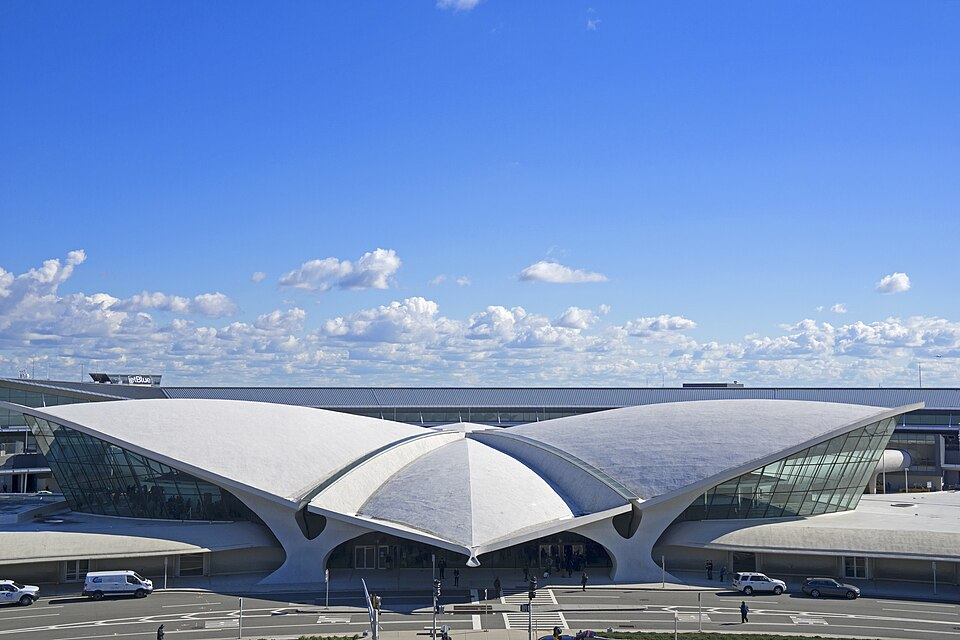
P1: TWA Flight Center at JFK
Photo: Swizz152 / Wikimedia Commons | CC BY-SA 4.0
Saarinen's TWA Flight Center at JFK was designed to make the act of flying feel like stepping into the future.
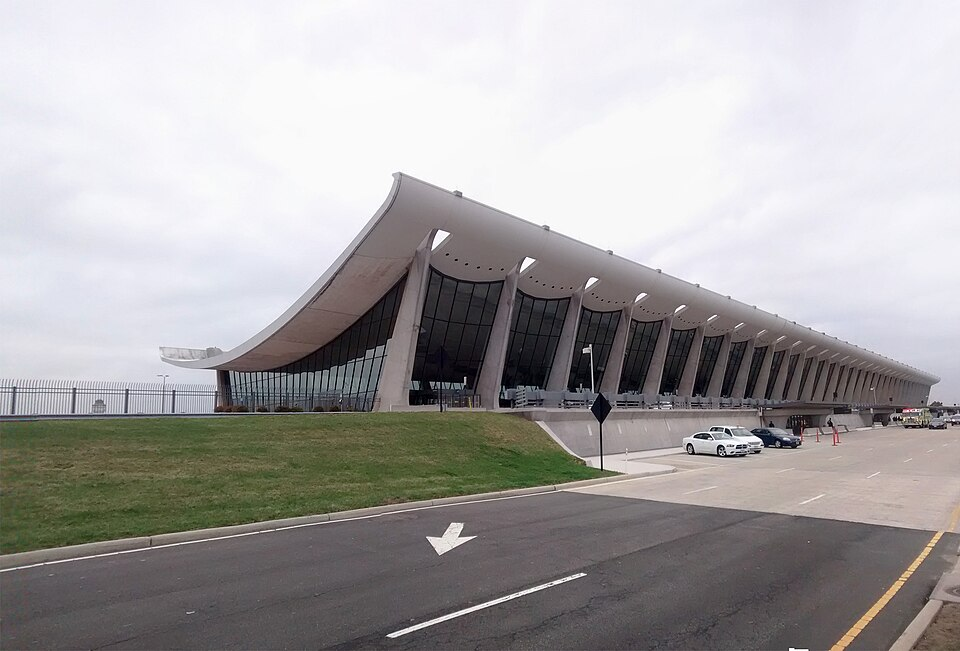
P2: Washington Dulles main terminal
Photo: Gunnar Klack / Wikimedia Commons | CC BY-SA 4.0
At Dulles, Saarinen translated that same optimism into a sweeping roof, monumental glass, and a terminal that still feels like a civic gateway.

P3: LAX Theme Building
Photo: Junkyardsparkle / Wikimedia Commons | CC0 1.0
Los Angeles answered the Jet Age with its own Space Age icon. LAX was not trying to hide aviation infrastructure; it was turning it into spectacle.
These places were not subtle about what they represented. Aviation was progress, and the architecture celebrated it. Of course, it is very easy to look backward through a nostalgic filter and pretend everything about flying in those years was wonderful, but it was not.
Air travel was inaccessible to many people, and terminals were not designed around the breadth of physical, cognitive, and sensory needs that we understand today. There is plenty about that era that absolutely does not need to return, but the optimism does. I want that belief that travel can be extraordinary without pretending the past was perfect.
When flying was part of the vacation
I was not around for the true height of the Jet Age. By the time I was growing up in the 1980s, that era was already fading, but what I did experience were its last remnants. There was still something special about getting on an airplane.
Flying was an event, and the flight was not simply the thing you had to endure before the vacation began. It was actually part of the vacation. Going to the airport felt like the beginning of something, almost a procession where arriving at the terminal, seeing the airplanes, going to the gate, boarding, and taking off were all part of the celebration of going somewhere.

This is how I remember it. Find the biggest window in the terminal, get as close to the glass as possible, and watch the entire world of aviation happening on the other side.
Even the airplane experience itself was strangely communal by today's standards. I mean, remember the movie? There was one movie, several screens around the cabin played the exact same thing, and that was your entertainment option. You watched it or you did not.
It sounds almost absurd now when every passenger can disappear into an individual screen and choose from hundreds of movies, shows, games, and whatever else happens to be available. Still, there was something about a whole cabin experiencing the same thing that contributed to the shared nature of travel. Flying felt like something a group of strangers was doing together.
I also remember larger aircraft appearing on routes that today might be flown by something considerably smaller, and the entire experience seemed to have more physical room around it. I do not mean that every seat was enormous or that every 1980s airport was some cavernous architectural masterpiece. What I remember is that the experience did not constantly feel compressed.
For me, one of the first really noticeable changes happened when you could no longer go to the gate with someone who was traveling. Before that, the airport was not exclusively occupied by people who had tickets. Families went to the gate together, you saw people off, and you waited for someone to arrive, so the beginning and end of a journey could involve people who were not actually taking the journey themselves.
When that disappeared, something about the airport changed emotionally. It understandably became a more controlled environment, but it also became a more transactional one. Then air travel kept growing while many of the spaces accommodating it did not grow at the same pace.
More passengers, more flights, more security, more concessions, more equipment, and more infrastructure were layered into terminals and gate areas that had frequently been designed decades earlier for considerably fewer people. You could feel it in the holdrooms, in the circulation, and in the simple challenge of trying to find somewhere to sit.

More passengers and more activity kept getting pushed into spaces that had never been designed for that density. Eventually, simply finding somewhere to sit became part of the airport experience.
The airplane followed a similar trajectory. Commercial aviation became astonishingly efficient at moving enormous numbers of people around the country, but the experience increasingly felt like transportation and little else. Get through security, find the gate, find somewhere to sit, board when your group is called, find space for your bag, get into your seat, and get where you are going. Somewhere along the way, the trip started after the flight instead of when you arrived at the airport.
Space and air | the Future of Airport Design
That is why some of the newest American terminals feel so different to me. The first things I notice are almost embarrassingly simple: space and air. You do not have to make people feel compressed and anxiety ridden just because they are moving through a very busy transportation hub, and there can be room around the experience again.
One of the strongest recent examples I have personally experienced is the international arrival process at Seattle-Tacoma. SEA's International Arrivals Facility replaced an undersized 1970s-era operation with a 450,000-square-foot facility and an aerial walkway 85 feet above the airfield. The difference is not simply capacity; there is volume, daylight, movement, and an arrival experience that actually feels like an arrival.
Orlando's Terminal C has given me similar moments, and Tampa continues to evolve in ways I enjoy watching. I desperately want to experience the new Terminal 1 in San Diego, although through some cosmic joke I keep flying in and out of Terminal 2 instead. The first phase of the new Terminal 1 opened in September 2025, replacing a terminal that had served San Diego for nearly six decades.
Pittsburgh's new terminal is very high on my list, as is spending real time in the rebuilt LaGuardia and watching what is now happening at JFK. Portland may be the one I am most annoyed with myself for not having experienced yet, because everything I have seen of the new PDX makes me want to go there specifically to see the airport. I am comfortable admitting I am not normal about airports.
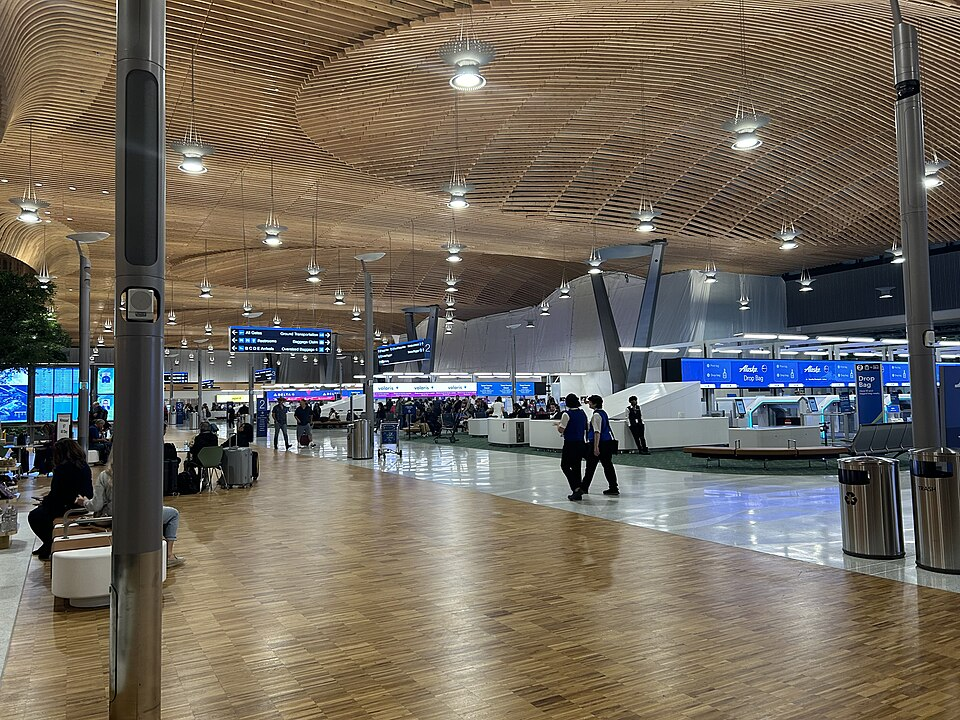
P4: Portland International Airport new main terminal
Photo: PortlandSaint / Wikimedia Commons | CC BY 4.0
The new PDX main terminal shows how a contemporary airport can feel unmistakably of its region, with a vast timber roof and a very Portland sense of materiality.
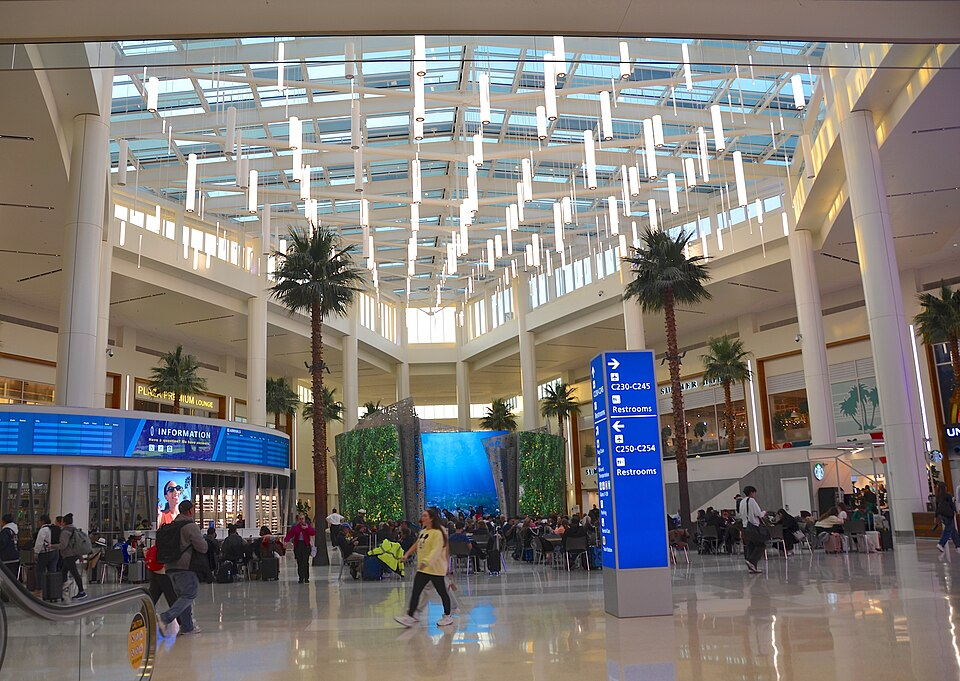
Photo: Olga Ernst / Wikimedia Commons | CC BY-SA 4.0
Terminal C at Orlando is one of the newer U.S. terminals that made me realize the airport itself could once again feel like part of the trip.

Photo: Silver Dovelet / Wikimedia Commons | CC BY-SA 4.0
The rebuilt LaGuardia is high on my list. Its transformation is a reminder that even an airport once synonymous with frustration can be reconsidered from the passenger outward.
What excites me about these places is not simply that they are new. Newness wears off very quickly if the underlying experience is bad. What I like is that designers seem to be reconsidering how a person actually occupies an airport.
You should not have to sit in the same gate chair for two hours because there is nowhere else to go. Maybe you want to eat somewhere that actually feels like a restaurant, maybe you need a quiet place, maybe your child desperately needs to run around for twenty minutes, or maybe you want a reflection space, an installation, or a museum exhibit. Sometimes you simply need to get away from the intensity of the gate area until boarding.
Or maybe you are me and you want to find the biggest wall of glass in the terminal and stare outside. Those views matter more than we sometimes give them credit for, because airports became so focused on accommodating all of the functions inside the terminal that we occasionally forgot the most fascinating thing about an airport is happening right outside it.
I want to see the airplanes. Give me an enormous expanse of glass overlooking the taxiways, runways, and gate areas, and let me watch aircraft arrive from somewhere I have never been and leave for somewhere I have always wanted to go. Let me see the ground crews, baggage carts, catering trucks, and all of the choreography involved in getting one airplane ready to leave while another arrives beside it.
That still gets me every single time. In those moments, I am right back to being that kid with his face against the glass, and I love that the newest terminals seem to understand the value of that connection again.
From placemaking to place mending
The other thing I am enjoying in these newer terminals is a much richer use of materials. Airports are finally remembering that they are actually located somewhere. Architecture has talked forever about placemaking, but while talking about this article I accidentally typed another phrase that I now cannot stop thinking about: place mending.
It was a typo. I meant placemaking, but I think I stumbled into something more interesting. Maybe some places do not need to be made, and maybe they need to be repaired.
For a long time, American airports became increasingly interchangeable. We could add a photograph of a local landmark, name a bar after a neighborhood, and call it a sense of place, but underneath those additions the terminal itself could still feel almost completely anonymous. Place mending goes further because it asks how we reconnect an airport with the city and region it represents.
Materiality is part of that. Wood, stone, terrazzo, planting, patterns, and color can all tell subtle stories about where you are without turning the building into a theme park. Food can do it, art can absolutely do it, and exhibitions and museums can do it too.
Phoenix Sky Harbor is becoming one of my favorite examples of this, and it is also one of the places where I am constantly reminded how much storytelling can happen inside an airport. The Phoenix Airport Museum has more than 1,000 works in its collection and more than 40 exhibition display areas spread throughout the airport system, which means there is regularly something new to discover.
I am always early for a flight. I know I am going to be early, and yet I still leave early enough to be early, which is simply who I am. I increasingly do not mind being early at Sky Harbor because I know I can wander around and find something interesting.
As I sat in Terminal 4 writing this article, there was an exhibition upstairs on the ticketing level about flight attendant uniforms through the history of aviation. The Runway Fashion exhibit showcases eight vintage uniforms from the airport's Aviation History Collection, and I had to laugh at how perfectly it fit the article I was already thinking about. Here I was excited about the future of American airports while the airport itself was reminding me how much nostalgia there is around the history of flying.

While thinking about the future of airports, I looked up and found Sky Harbor reminding me about the history of air travel. I do not think that timing is strange at all.
I do not think that timing is strange at all. I think we are beginning to recognize that something valuable disappeared when air travel became entirely ordinary. We do not need to recreate the exclusivity or every ritual of the past, but we can absolutely recover the feeling that aviation is worth being excited about.
The future should also be kinder
What makes me even more optimistic is that today's airport can do something the great Jet Age terminals did not always do particularly well. It can pair that sense of wonder with a much deeper understanding of the people actually using the building. That shift may be less photogenic than a soaring roof, but it matters just as much.
As I sat at Sky Harbor, airport announcements kept reminding travelers about some of the programs and recognition PHX has received. One that caught my attention was the airport's Dementia Friendly Air Travel Workshop, which brings airport, airline, and TSA representatives together to help travelers with dementia and their caregivers understand and prepare for the travel process. Phoenix was the first airport in the country to offer this type of workshop, and it was recognized by Airports Council International North America as the best Customer Experience Program for Large Airports in 2023.

The future of air travel is not only about dramatic architecture. It is also about recognizing that every traveler experiences the same airport differently.
I love this because it represents exactly the kind of future I want, even though it does not create some spectacular architectural photograph. The airport of the future should absolutely amaze me, and I still want the soaring ceiling, the enormous window, the beautiful materials, and the art. I want all of the things that make me stop and look around.
But that airport should also recognize that the person standing ten feet away from me may be experiencing that exact same environment completely differently. They may have dementia, low vision, or hearing loss; they may be autistic or have another sensory disability; they may have mobility limitations; they may be traveling with a child who has simply reached their limit; or they may just be anxious, exhausted, confused, or overwhelmed. The airport of the Jet Age asked us to imagine what technology could make possible, while the airport of the future should also ask what design can make easier.
Nashville, Dolly, and what a legacy can become
Then there is Nashville, and this part of the story has become much more poignant in just the last few weeks. Dolly Parton died in Nashville on August 25, 2026, at the age of 80. Less than three weeks later, the Metropolitan Nashville Airport Authority voted unanimously to begin the process of modifying BNA's name in her honor, although the final name and implementation are still being worked out.
That alone moves me, because few people are more instantly connected with Tennessee in the minds of people around the world. One of the organizers behind the airport naming campaign has proposed taking the idea further by creating an Imagination Library space inside the terminal where children could get books while waiting for flights and families could learn about the program. To be clear, that library space is still an idea, not an approved airport project, but I hope somebody runs with it.
The possibility excites me deep to the core because now the idea carries even more meaning. Dolly spent decades building the Imagination Library around a beautifully simple belief that children should have books in their hands, and after her death her family asked that people honor her through donations to the program. Imagine what it would mean for a child to pass through an airport bearing Dolly Parton's name, pick up a free book, and take it along on the journey.

Imagine passing through an airport bearing Dolly Parton's name and leaving with a book from the program she spent decades building. A memorial can remember someone; an experience can carry their legacy forward.
That would not simply be branding. It would be legacy made tangible, because the airport would not just be using Dolly Parton as a name or image; it would be participating in something she valued and spent decades building. A traveler would not simply encounter her photograph on a wall, because a child could actually experience one of the things she believed in.
This is exactly what I mean by place mending. An airport can tell you where you are, but the best ones can also tell you something about the people and values of that place. In Nashville, there is an opportunity to do that in a way that feels especially meaningful now, because a name can honor Dolly Parton while a book handed to a child can help carry her work forward.
Technology that gets out of the way
Technology can support all of this too, although I am not talking about the technology in our pockets. I am much more interested in the technology built into the terminal that makes the physical experience easier. Interactive directories are a great example because I can find a restaurant, a quiet place, an art installation, a children's area, or whatever else I need, and the system can actually show me how to get there.
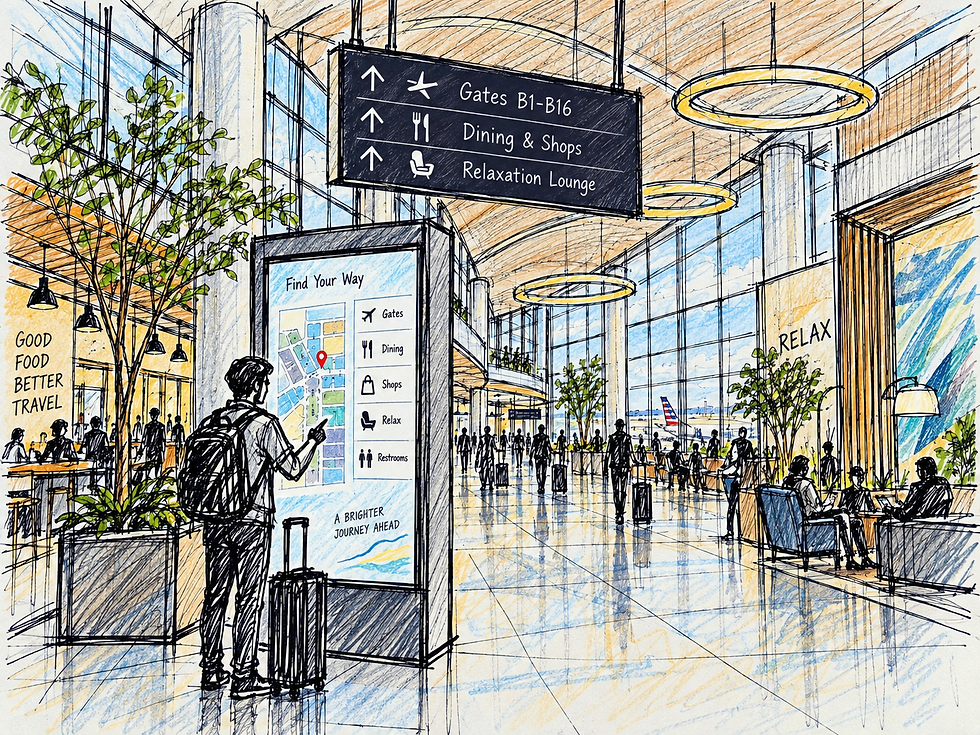
The best airport technology does not need to announce how futuristic it is. Sometimes the future is simply knowing where you are going and how to get there.
That sounds simple, but anyone who has stood in an unfamiliar terminal staring at a static diagram while trying to determine whether they have enough time to walk somewhere understands how valuable it can be. If something in the airport changes, the information can change with it. The best airport technology should quietly remove friction and help the building make sense instead of adding another screen demanding our attention.
Now give me the airplane
All of this makes me enormously optimistic about the direction our terminals are heading, but there is one increasingly obvious problem with all this progress: eventually I have to get on the airplane. The contrast is becoming increasingly strange when I can walk through an extraordinary new terminal filled with daylight, art, great materials, interesting places to sit, thoughtful accessibility features, and technology that makes the journey easier, then walk down the jet bridge into an aircraft experience that still feels overwhelmingly transactional.
Today's airplanes are extraordinary machines. They are quieter, safer, more efficient, and more technologically advanced than the aircraft I grew up flying on, but do they make me feel the way Concorde must have made someone feel when they saw it waiting at the gate? That is the question I cannot stop asking, because I want to know where our Concorde is.
I do not literally mean bring Concorde back. What I want back is what Concorde represented, which was the audacity to suggest that tomorrow might actually be more extraordinary than today. I want to look through one of these enormous new terminal windows and see an aircraft sitting at the gate that makes me think, I cannot believe I get to fly on that.
There are at least hints that people are trying again. Boom Supersonic continues developing Overture after its XB-1 demonstrator achieved supersonic flight, and NASA's X-59 first exceeded the speed of sound in June 2026 before reaching Mach 1.4 at 55,000 feet during its test program. None of that guarantees that we are heading into another age of routine supersonic passenger travel, but at least people are asking the question again.
That matters to me because American airports are asking their own questions again too. What if waiting for a flight did not have to be miserable? What if a terminal could make a crowded experience feel spacious, accessibility was considered from the beginning, materials actually told you something about where you were, and art and museums made arriving early enjoyable? What if a child could someday leave Nashville with a free book, or someone with dementia could enter an airport with a little less fear because the airport had already thought about their experience?
I do not want the 1960s back. I want something better, with Saarinen's confidence and drama combined with everything we now understand about accessibility, psychology, technology, and human-centered design. I want the excitement I remember as a kid combined with spaces that recognize that not everyone experiences travel the way I do, and I want airports that feel unmistakably connected to their cities and regions instead of interchangeable with somewhere else.
I want the journey to begin at the airport again, because after decades when we seemed to accept that air travel was simply transportation, I am starting to see evidence that we can expect more from it. We are not trying to recreate the Jet Age; we are taking some of what made it magical and building something more thoughtful around it. Maybe that is what place mending really means, because we are repairing the connection between travel, people, and place while putting some of the wonder back in a way that more people can experience.

If our terminals are finally starting to look and feel like the future again, I am ready for the airplane waiting outside the glass to catch up.
If we can keep doing that, I have only one thing left on my wish list. When I walk through that beautiful new terminal, wander through an exhibit, find a quiet place to sit, look around at materials that tell me something about the city I am in, and eventually make my way toward a giant wall of glass overlooking the airfield, I want to see something outside that stops me in my tracks. I want to find myself standing there again, face nearly pressed against the glass, staring at an airplane and wondering what comes next. That is the future I want from air travel, and I want it badly enough to say it one more time: give me the future again.
JAD Design Services is a Phoenix-based architecture and design practice led by architect Jason Danielak. The studio focuses on thoughtful, highly personal design across residential, commercial, and specialty projects, with an emphasis on clarity, experience, and creating places that feel distinctive, human, and connected to their context.


Comments